Sunday, November 22, 2009

The Movies Go To the Movies: Lethal Weapon

Lethal Weapon (1987, Richard Donner)

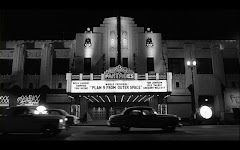
The Wiltern Theatre

Along with Die Hard, Lethal Weapon was one of the major action template movies of the 80's and it's influence is still being felt today, the Rush Hour movies being a prime example. I rewatched it recently for the first time in at least a decade and a half; the script by highly paid at the time screenwriter Shane Black lends a certain wit and attitude to a rather nondescript plot that floats from action set piece to action set piece without taking any pause for logic. Director Richard Donner moves things at a brisk enough pace that it's not until a post viewing mental summation you realize that the parts don't really add up to a coherent sum, but by that point, it doesn't really matter.

More to the point of this blog post, at about the thirty minute mark Seargants Riggs and Murtaugh take a break to get a hot dog on the corner of Western and Wilshire:


If you are a fan of those funny pages games where you try to figure out what's askew in a particular picture, you would have noticed two things off kilter in this frame:

1.) The Wiltern, though originally a movie theatre, was by it's 1985 rennovation converted to a concert venue.

2.) Lethal Weapon was released on March 6th, 1987, while The Lost Boys, which is here regaled as "This Year's Hit" would not hit theatres until July 31st, 1987.

Well, as for the first point, it's a movie they do that. On the second part, a little wishful thinking on the part of the executive producer of The Lost Boys, who is none other than Weapon director Richard Donner.

Ah, cross promtion/in-joke synergy!

Tip of the hat to Heath for the suggestion.

Friday, November 13, 2009

The Crackdown

Death Wish IV: The Crackdown (1987, J. Lee Thompson)

Death Wish IV opens with a familiar set-up: A lone woman walks through a desolate parking garage looking for her car. Upon reaching the vehicle, which, don't you know, won't start, she sees a threatening looking hoodlum in the distance. She blinks and there is a second hoodlum and then a third. Things look dire for the poor woman, until, hurrah noted scum-blowing-awayer Paul Kersey (Charles Bronson) arrives with his trusty, large, and in no way phallic, revolver to exterminate the anonymous hoods one by one. But as he reaches the last no good punk, and remove his mask to look him in the eye, the face that Kersey sees is his own!!!! Before you can say Holy Luke Skywalker in Empire Strikes Back we cut to Kersey waking up in his home. It was all a dream.

Considering that Kersey didn't wake up masturbating, we can assume that for the first time in the Death Wish series, the character is confronted with a bit of self analysis. Does Kersey see himself as partaking in a role that is cyclical and is his willingness to bend his morals for vengeance's sake eventually going to led to a self destructive prophecy? Okay, no, that will never be mentioned, but the allusion, however tenuous coupled with the illusory nature of the opening scene are the first signs that we are no longer being led by the indifferent hand of parts 1-3 director Michael Winner. J. Lee Thomspson, himself a journeyman with a similar hit and miss oeuvre to Winner takes over the reigns (and yes it's a dream sequence, but based on Winner's directorial display in the first three, he would have not thought to delineate any formal differences between reality and the dream). But alas, if you thought (or feared) that the long standing right wing revenge thriller cum exploitation series would change, or gasp, grow a conscience, your fears are unfounded, the rest of the film hews close to the series' template, although with some appreciated tweaks.

Paul Kersey's urban tour of duty hops back to Los Angeles (as in part II), where he is back to being an architect (his 9 to 5 job) and is living with his fiancee whose daughter is like a daughter to Kersey, we know this because Kersey says to her "you're like a daughter to me", which if you know the history of the guy's offspring is not really the most comforting comparison. Well, you know where this is headed, the step-daughter is led to a life of drug addiction via her Ian Zering look-alike boyfriend and overdoses.

After a bit of platitudes about the dangers of drugs (there is a scene that plays out pretty much like this: Kersey: Drugs are bad and dangerous to our society. Other Person: Bad, you say? Tell me more about this philosophy of yours.), it takes about five minutes for Kersey to rid the world of the punk who sold the cocaine that killed his daughter. Hey, he's an old pro. But then the film changes course and Kersey is offered unlimited money, weapons and resources by a rich dude who claims to have lost his child to drug culture (spoiler: this rich guy is not altruistic but the main bad guy who wants to rid the street of his competition! You would probably get the subtle hints if you've ever seen a movie before) to clean the streets. Kersey takes him up on his offer with a "shit, I've been doing this for free for the last thirteen years" glare. This new plot device allows for a twist in the unfortunate class distinctions that plague the first three films, where upper class bourgeoisie Kersey is consistently at war with criminals from more lower class background, or to but it more bluntly poor unmannered people attack rich mannered people, rich person becomes unmannered, kills poor unammanered people, audience cheers.

While I complained about some of the cartoony aspects in the violence of Death Wish III, I kind of dug the more over the top elements of DWIV, with Bronson going undercover in scenes, including as a waiter in a restaurant where he offers the mobsters an explosive bottle of wine and an epic dummy falling to his death scene. I guess either the Cannon mystique finally rubbed off on me or I was more willing to accept it due to the lack of involvement of dancing children or the elderly. Or perhaps Thompson's better at this sort of thing.
Death Wish IV is more of the same, and I wouldn't recommend it unless you are a diehard Bronson fan or are reviewing all the Death Wish films for your blog or something, but as someone aware of the blueprint, I kind of dug the slight alterations it offers. If you only see four Death Wish films, make sure this is one of them.

Saturday, October 31, 2009

It's 9 O'Clock Boys and Girls, Time to Put on Your Silver Shamrock Masks

Enjoy!

Muwahhaahahaah

24 Frames: Halloween


Here's one second worth of frames from Halloween (1978) directed by John Carpenter, cinematography by Dean Cundy. Make sure you return here tonight at 9pm for the big giveaway!


Friday, October 30, 2009

The Good, The Bad and The Ugly of Rick Rosenthal's Halloween II

A couple of days ago I gave a breakdown on the myriad of the quality gamut for Rob Zombie's 2009 sequel to his Halloween remake, I thought in fairness, I should give equal treatment to the other film with the title Halloween II. Make sense? I hope so. Oh, and Rick and Rob share another interesting commonality amongst themselves, they are the only people to direct two films in the Halloween saga, with Rick's 2002 entry Halloween: Resurrection being even more wretched than either of Zombie's films.

Spoilers, ye be warned

The Good:

-I think what appeals to most viewers, and me too, at least to the extent I had considered this a genuinely "good" film until recently, is that it takes place almost literally the second after the original ended. While the film ultimately doesn't work as a whole, the gimmick of making the first two films take place over the course of the entire day, or at least once Laurie Strode's character is introduced, plays into various what then? questions or theories viewers might have formulated after constant reviewing and analyzing of the first film.

-Most of the characters (and actors) from the first film return, which other than obviously Donald Pleasance and Jamie Lee Curtis, means that Charles Cyphers is back as Sheriff Brackett as is Nancy Loomis in a cameo as his deceased daughter, Annie. Brackett seeing his murdered daughter provides some weight to the proceedings and a scene we rarely see in slasher movies, the parent coping with the death of their teenage child. We also learn the fate of Laurie's crush Ben Tramer.

-This is the movie where Donald Pleasance lets his ham freak fly, he's great here and increases Loomis' obsessive relationship to his former patient. Plus he gets a wonderful line at the beginning where stewing over losing Myers, an awakened by the racket neighbor tells him to quiet down because "I've been Trick Or Treated to death tonight" to which he impudently replies "You don't know what death is!" Cue the famous Carpenter score and opening credits. This is the best moment of the film.

-While I find Dick Warlock's portrayal of "The Shape" severely lacking, there's a wonderful moment where he finally gets Laurie within his sights and he just walks through a glass door without pause. It's the only time Warlock approaches the conviction of Nick Castle's original performance.

-The final shots of the film: Laurie being taken from one hospital after surviving a night of horrors to god knows where with an expression of complete blankness on her face. She finally has a moment's pause to reflect on what just happened in the last 12 or so hours...CUT TO...Myers on fire, his mask in flames...FADE OUT...end of film. This is more unsettling than anything in either of the "trying too hard to be unsettling" Zombie films.


The Bad:

-While most of the surviving cast returns, what happened to the kids, Lindsay and Tommy? I realize that the actors would have looked the most different of all the cast in the three year gap between films, and thus would not be able to reprise their roles, but recast or at least a mention of them would be appreciated.

-Speaking of missing cast members, don't you think the Strodes would want to visit their daughter in the hospital, even if she is (and we'll get to this in the Ugly section) "adopted".

-The first film features a body count of five, but over the course of Halloween night, only three. The sequel really amps up the number of killings, a pardon the pun, stab at, ironically enough, keeping pace with the Halloween slasher film imitators that popped up with great frequency after the originals success. It seems like Myers goes out of his way to kill people here, with none of the watching or premeditation that the original film established.

-Speaking of killing, and again this was probably a response to the imitators, Myers uses a plethora of weapons in II whereas in the original he uses either a knife (a phallic extension) or his hands. I prefer the more primal Myers over the hot tub dunking one.

-The first Halloween has atmosphere and is scary, Friday the 13ths and other imitators ramped up the gore, Halloween II exists somewhere between, trying to emulate the originals suspense but without the assured pacing of Carpenter's film while trying to up the gore quotient. In that regards it fails to reach the heights of the work of someone like Tom Savini. The result is a film that's neither scary nor gory. According to IMDB, which is not all that reliable (at least two of the trivia bits they state for the film are false), Carpenter added the gore scenes after shooting, which makes sense as they feel like an afterthought.

-Too many fake jump scares, yeah the first film has it's share, but here it's a crutch that is relied on too much. Example: a cat jumps out from a previously closed dumpster, a minute or so after it's already been opened to provide a "shock"

-For the most part they recycle the original theme, which I am fine with, it's the same night, the theme is iconic, why not? But they add little flourishes (not sure if this was Alan Howarth's contribution, he's listed as a second composer in the credits) which are distracting for those like myself who are intimately familiar with the original score.

-Am I missing something, why is everyone constantly blaming Loomis for Myers' escape. Was he responsible for security at the Haddonfield Mental Hospital? Loomis was the only one who was prepared for his return and he did plug a chamber's worth of bullets into him. It's not his fault Myers escaped and is virtually unkillable. Lay off the guy.

The Ugly:

-Like I said before, Nick Castle had a deliberateness and grace in his portrayal of Myers that Dick Warlock just doesn't possess, we don't see the voyeuristic aspects of Myers here, he pops up, jumps from out of nowhere, it is what it ultimately is, a stunt man doing stunts, not an actor giving a performance.

-The direction. What better way to compare a visionary director to an anonymous one than watching Halloween and part II back to back, granted as a producer Carpenter probably oversaw a lot of the production (which would have been right smack between Escape From New York and The Thing), but there's no pacing, the deliberate nature of the first film is completely gone leaving us with a hurry up and get this done with tempo, the shot compositions are lazy (even with cinematographer Dean Cundey returning), the film suffers from bad editing and most of all, it just is not suspenseful. In Rosenthal's defense, the script, by original Halloween scribes Carpenter and Debra Hill is no great shakes.

-The Sister thing. The twist that effectively killed the mystery and much of thematic elements of the first film and gave Myers, who originally embodied unclassifiable evil, a lame and simple purpose. He was no longer "The Shape" or "The Boogeyman" he became "The dude who wants to kill his sisters". John Carpenter himself even dismisses this addition as a gimmick, put in to capitalize on the Luke Skywalker-Darth Vader paternal relationship in Empire Strikes Back. What's worse, is there's no thought put into it, and only 2 scenes that mention the sister-brother link, a fuzzy focus flashback that Laurie has in the midst of her hospital recuperation (because that's when I always randomly recall the one time my mother told me I was adopted and then took me to meet my mute murderous older brother) and when Loomis' doctor pal, Dr. Exposition, er, Marion, informs Loomis of the familial connection. I would appreciate someone doing a fan edit of the film and remove those scenes, even if it wouldn't completely redeem the film. What's most upsetting is that everyone takes Laurie and Michael's relationship to be canonical, Rob Zombie who claimed that he either hated or never saw the sequels made it a major factor of his two films and I even have friends who are convinced the baby sister is seen at some point in the first scenes of the original film. FYI: She's not.

In conclusion, if you must see a movie named Halloween II, definitely make it the 1981 Rick Rosenthal directed film. But your best bet is sticking with Carpenter's original or the Myers-less Halloween III: Season of the Witch, the two self contained entries.

Thursday, October 29, 2009

Some Scary Songs for Your Halloween Party Playlist

Ministry "Everyday is Halloween"


Siouxsie and the Banshees "Halloween"


The Dream Syndicate "Halloween"


Michael Jackson "Thriller"


Bobby Pickett "Monster Mash"


And last but not least, Mr. Show blows the lid off "Monster Parties"

Wednesday, October 28, 2009

Trailers of the Moments: The Halloween Series (The John Carpenter Edition)

Let's take a look at the trailers for the three Halloween movies that John Carpenter served a major role in the production of, either as co-writer (all three), producer (II and III) or director (the original).

Halloween (1978, John Carpenter)


Two points of interest: 1.) Very spoiler heavy 2.) With one or two exceptions, pretty much cut in sequential order


Halloween II (1981, Rick Rosenthal)


You can tell the difference in the movement of Michael Myers in this film, after the original actor, Nick Castle, was not rehired. There's a grace and rhythm to his performance that's lacking in all the other sequels, especially lame is the little pirouetted jump in the early attack scene shown here. Curiously, Jamie Lee Curtis is relegated to a minor selling point in this trailer, not appearing until the final thirty seconds. Also, no hints at the eventual lame reveal of her character's relationship to Myers' twist.

Halloween III: Season of the Witch
(1982, Tommy Lee Wallace)

I like that this trailer doesn't feel compelled to explain why part III doesn't pick up where the first two Halloween films left off, although ruining Cochran's scheme in the first seconds of the trailer is unforgivable.

Tuesday, October 27, 2009

The Good, The Bad and The Ugly of Rob Zombie's Halloween II

Call me extremely forgiving. Call me a masochist. I had disliked each of Rob Zombie's three films released prior to Halloween II, and what's more I was actually seeing diminishing returns from his debut to the horrendous misguided remake of John Carpenter's original 1978 classic Halloween (yes that means House of 1000 Corpses is still my "favorite" film of his). What's more, even though I was one of the few that found The Devil's Rejects lacking, I was actually looking forward to someone with a specific aesthetic and apparent respect for the past like himself dealt with the task of remaking a masterpiece versus some anonymous video director that Platinum Dunes got on the cheap. Figuring that if it has to be remade, you know, at least it's by someone distinctive.

Of course, the result was a maddening disaster. Zombie stripped any mystery from the Michael Myers story, amped up the hillbilly dialects from Rejects to a self satirical level, condensed the entire ninety minute running time of Carpenter's film into about a third of the time in the second half of the film (yet Zombie's movie was still nearly twenty minutes longer) and shot a film that was incomprehensibly dark, and well, looked like a film from some anonymous video director that Platinum Dunes got on the cheap. All the while he maintained the guise of someone who never cared for the sequels, yet made Laurie the sister of Myers, something that is never mentioned until the original Halloween II (1981, Rick Rosenthal), a plot point that Carpenter added in the wake of Empire Strikes Back revealing Luke Skywalker to be the son of Darth Vader, and one that destroys what I like best of the original, a lack of psychoanalytical reasoning for Myers motivation, something that will always be eerier to me than any weak "oh that's why he does that" explanations.

So why did I make sure to see his follow-up upon theatrical release (in the very Halloweeny month of August--sheesh, Weinstein Company no wonder your nearly bankrupt)? Honestly, I don't know. I am a horror fan and often times that means being a gluten for punishment.

Halloween II
is even more of a Zombie film, full of his fetishes and barring his unmistakable fingerprints. Yet, I found it interesting, albeit it in a train wreck sort of way.

So let me provide you with some bullet points of the three levels of madness that is Rob Zombie's Halloween II. A name of a good psychiatrist is welcomed in the comments.

BEWARE: SPOILERS APLENTY HERE

The Good:

*An actual honest to goodness suspenseful sequence. Something completely lacking in the first remake. Laurie trapped in the hospital, hopped up on drugs and barely able to walk wakens to find all the nurses and doctors murdered and Myers after her. For once Zombie forgoes his normal punishing brutality in favor of placing us in Laurie's predicament, knowing as much or little as her (of course he ruins the whole thing by inexplicably making this a dream sequence)

*Brad Dourif, one of my favorite actors, gives a strong performance and provides the film some rare heart.

*For all the bad that I associate with Zombie's self created world, I do kind of wish that we lived in a place where a black and white live performance of "Nights in White Satin" by The Moody Blues and bizarre old scary cartoons were on television regularly.

*Hard to fault someone for giving quality genre character actors like Dourif, Malcolm McDowell, Dayton Callie, Margot Kidder, Danielle Harris, Mark Boone and Howard Hessman a paycheck. And to his credit, the cameos are a lot less disruptive than in H1, with it's "Hey everybody it's Ken Foree!!" elbow jabs to the audience.


The Bad:

*The dialogue is just as inane as ever. Hope you like ersatz hillbilly talk and the word "fuck" and a complete lack of nuance between characters. And if you thought Tarantino's dialogue for the women in Death Proof rang false, wait until you meet the teenage girls of H2 who function as a in-film DVD commentary of Zombie's personal taste. The worst exchange, that sadly Dourif is saddled with, is this choice line: "Who's the original Marvin, you know from the phrase Starving like Marvin?" (I'm paraphrasing here)

*Ruining the first and best minutes of the entire film by making it an inexplicable dream sequence (have I used the word "inexplicable" a lot here? I guess its an appropriate adjective for the oeuvre of Mr. Zombie). I wonder if Zombie intended to kill her off but was told by the Weinsteins they needed to keep her around for a semblance of continuity or familiarity and so he decided, what the fuck, I won't change the opening, just make it a dream sequence.

*A year after being brutally attacked by a slasher who murdered her friends, Laurie's hanging up posters of Charles Manson above her bed? Whaaaa?

*I didn't mind the not at all scarred despite having his eyes popped out Dr. Loomis becominh a self sanctimonious blowhard cashing in on his relationship with Myers for fame, but his character arc which finds him making a major, life threatening decision, felt forced.

The Ugly:

*The film is even more visually and narratively incoherent than anything Zombie has done before, featuring fast cut sequence that reek of amateur community college arty music videos. The film is too dark and the pace too frenetic.

*The opening where we cut from a life saving surgery for Laurie from injuries accrued in the first film to Michael Myers inevitable waking up is just brutal, which granted was the director's intention, but the close up medical procedures crosscut with the rampage of Myers is audience punishing.

*The white horses. Yes, even though she dies in the first half of part one, Sherri Moon Zombie remains gainfully employed by her husband appearing as a spectre and a picture into the mind of Myers (bleh) accompanied by a white horse which were told in an opening preface is symbolic of something or other. What it's most likely symbolic of is a psychology book Zombie had lying around the house and happened to pick up during the writing process.

Well there you go, I will probably not like it, but will also most suredly seek out his next project, yet another remake, this time of The Blob. Can't wait to see the psychoanalytical manifestations of a rampant Jello's mind.