In wake of the sad news of make-up and special effects designer (and director of Pumpkinhead!), Stan Winston, I would like to thank him, as well as the likes of Rob Bottin, Rick Baker and Tom Savini, for his lovingly detailed oriented approach in both handmade and digital effect rendering and instilling in me a predilection towards his ethic over the ever increasingly lazy and over saturated CGI approach that is all too common these days (see the new Indiana Jones film, the Star Wars prequels, Transformers, et cetera).
Here's a link to an appreciation at Ain't it Cool from some of the directors who he had collaborated with throughout his illustrious career, including James Cameron, Joe Dante and Frank Darabont.
And here are some of his most notable creations:
The Terminator: Predator: Edward Scissorands: Terminator 2 (The T-1000): Jurassic Park (T-Rex): Those last two creations particularly wowed this author in his teenage years.
I'd be remiss if I skipped another Friday the 13th without paying homage to the film series that helped increase awareness of the peculiarities of this date.
The first experience I've ever had with the horror genre was at the age of seven, when late one night I snuck into the kitchen and caught a few minutes of Friday the 13th part III which my father was watching on Betamax in the living room. Obviously, my life was forever altered. It wasn't until part VII (The New Blood) in 1988 that I was able to see a Friday the 13th film theatrically, though I do remember catching some scenes from part VI by ever so slightly contorting my head in the direction of another screen at the Drive-In when I was ostensibly watching Howard the Duck. True story! What's more, I actually kind of liked Howard. Hey, I was 10.
So in tribute to the series that I had memorized as a teenager, I am posting this video I found on YouTube that features every kill scene from every Friday movie. This video is obviously not safe for work, unless, of course, you work as a counselor for Camp Crystal Lake, in which case, please study the footage and use it as an educational tool.
And because it wouldn't be Friday the 13th without a quickly produced follow-up, here for you title sequence enthusiasts are the opening titles to each film:
I particularly enjoy the fidelity in the usage of the boldly fonted title fast approaching the screen in the first three films (crashing into and breaking glass in part I, exploding in part II, comin' at you third dimensionally in part III). For part IV aka The Final Chapter, judging by the way the title is written, the graphic design budget must have been cut severely, however slight redemption comes by way of having the subtitle collide with Jason's hockey mask causing a dramatic explosion!?! (Kids remember, the combination of hockey masks and titles may cause combustion!) For part V aka The New Beginning, they bring back the original title font but the twist this time is that the hockey mask collides with the title causing the explosion (see, it is a new beginning after all). Part VI, Jason Lives, features the awesome Bond reference as well as two firsts: the first time the size of the subtitle is exponentially larger than the Friday the 13thportion as well as the first time the font in the title was represented in the scrawling manner matching the type on the posters. This would be replicated in the title sequences of part VII (which this time has the hockey mask crack in half) and part VIII, which is the first time the title is printed atop an actual filmed image, stock footage of Times Square circa 1989. The less said about the cheap computer graphics utilized in the three New Line films, the better.
Like any good zombified homicidal maniac, you can't keep Jason away for long, the series will get a reboot next year when Michael Bay's production company, Platinum Dunes, will release a remake. Yes, that's the same company that has released remakes of Texas Chainsaw Massacre, The Amityville Horror, The Hitcher and has remakes of The Birds (gasp!) and Rosemary's Baby (double gasp!!) in the pipeline. You may remember their company credo: "Original Thought? Yo, Fuck datnoize!"
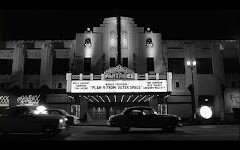
Ed Wood (1994, Tim Burton) The Pantages Theatre, Hollywood, CA
"This is the one, this is the one I'll be remembered for"
Seeing as I am as much a movie theatre geek as I am a movie geek, I thought I'd add a new feature (because if there's one thing my blog needs-it's another rarely updated feature!) consisting of shots of movie theatres in movies. Caveat: I plan on focusing on theatres I've been to or whose locations (current or old) I am aware of, which pretty much consists entirely of those in Northern or Southern California, the former where I grew up and the latter where I currently live, though if I catch an image of a movie theatre I know from my travels, I will include that as well.
The inaugural entry is from one of my favorite films of the 1990s, Ed Wood, a film in which screenwriters Larry Alexander and Larry Karaszewski and director Tim Burton recontextualized their subject's life, the man considered the "worst director of all time", as a triumph, whilst not completely dismissing personal issues (alcoholism, exploitation of friends). The screenwriters accomplish this by structuring the film around Wood's friendship with Bela Lugosi and telling the story entirely from the director's perspective. In the DVD commentary the writers make mention of how Sarah Jessica Parker's character was seen by many a viewer as a villain, but in reality she was saintly to a fault and stayed with him long past the point most would.
Ed Wood also has a personal connection for me. In 1993, I was assisting my uncle, a low budget horror filmmaker in his own right, with a film shoot on a day when a few blocks down Burton and company were shooting a scene on Hollywood Blvd (a scene of Martin Landau and Johnny Depp walking and talking). I got to see a couple of takes and how much loving detail the filmmakers put into recreating the era, which is evident in the film with it's black and white cinematography and drunk in love with the B-movie ethic of the era tone.
The Pantages Theatre opened on June 4th, 1930. Howard Hughes purchased it in 1949 and in the fifties it served as home for the Academy Awards. In 1977 it shifted from a cinema to a live theatre venue. For the last two years Wicked has been in performance there. Three years ago, I saw a concert by a person with a slightly higher critical artistic reputation than Mr. Wood, Bob Dylan.
Just a guess, Plan 9 From Outer Space probably never played there.
...was the attached trailer for David Fincher's new film, The Curious Case of Benjamin Button, based on a F. Scott Fitzgerald story about a man aging backwards starring Brad Pitt as the eponymous Mr. Button with Cate Blanchett and Tilda Swinton. In case you missed Indy, your theatre didn't have it attached to your print or you were distracted by the confused reaction it elicited in your audience, here it is...en espanol (for some reason an English version is unattainable) but since the imagery and mood evoked are the most indelible aspect of the trailer, nothing much is lost in translation.
Despite committing the trailer sin of using a piece of music best identified with another film, in this case "Aquarium" by Camille Saint-Saens, given the fact that that music is most associated with Terence Malick's Days of Heaven and Visions of Light, the documentary about cinematography, I'll excuse it as an homage and possibly a throw-down announcement that this film is going to bring it beautiful image-wise.
It opens December 19th.
As for Indiana Jones, enough finger sweat has been spent on it already. It's pretty "eh" for me, definitely not as bad as some naysayers will have you believe but I am afraid any over-enthusiastic responses are probably due to a Pavlovian response to the familiar milieu.
Some personal notes (Beware Spoilers): The Good:
--The opening Paramount Pictures mountain logo dissolves literally into a "molehill", a clever joke on Spielberg's part admonishing to the template while accepting that perhaps the audience is putting too much stock in it's need for this sequel.
--Cate Blanchett imitation of Natasha from The Rocky and Bullwinkle Show worked for me surprisingly more than either her Kate Hepburn and Bob Dylan impersonations.
--Indiana Jones' reaction upon seeing Marion Ravenwood for the first time and his admittance that despite all the other girls, the problem was: "None of them were you". I wonder how Spielberg's wife feels about that meta-commentary on the annoyances and blandness of the other Jones' girls.
--Ford's fedora grab from Shia LeBeouf in the last scene.
The Not-So-Bad
--Harrison Ford is more vibrant and alive here than anything he's been in since, oh, Air Force One? The Fugitive? Unfortunately, that still equates to half-somnambulist.
--I was fearful of Mr. LeBeouf, but he's actually okay here, keeping his inherent smugness to a minimum. Also grateful that the not-so-stunning reveal of Mutt William's heritage occurred fairly early.
--The reveal of the Ark of the Convenient was cute, if a little pandering.
--Structurally, the film "felt" like an Indiana Jones film, which is more than I can say for the Star Wars prequels.
--It was great to see Karen Allen, but with the exception of some driving duties, Marion Ravenwood is given very little to do.
The Bad
--A potentially great chase scene soon unravels when Spielberg and company go overboard on the CGI. Look I realize that CGI is unavoidable, but it shouldn't be so distracting. My favorite film of last year, Zodiac, is full of CGI, but it's weaved into the fabric of the cinematography stealthy enough that I was never once taken out of the film. I feel especially disappointed because Spielberg normally utilizes CGI effectively, as evidenced in Jurassic Park and AI. I don't want to bag on Lucas, since he didn't actually "direct" Crystal Skull, but it felt like the Star Wars prequels where so much visual stimuli occurs in the frame that the viewer is assaulted into exhaustion which soon evolves into boredom. Same goes doubly for the final set-piece which is pretty much consists solely of actors shot on green screens reacting to bad computer graphics.
--The "MacGuffin" that so excited George Lucas...what the fuck? Keep it simple, bro.
--Two words: The monkeys.
While I had a decent enough time, unfortunately nothing in the film got to me the way the two minute trailer that preceded it did. It was like an evening spent with old friends you haven't seen since high school. It was nice to see them again, learn what they've been up to, but there was a reason that you haven't seen them in years and despite some precursory niceties, you probably won't ever see them again.
And I definitely have no interest in seeing Mutt Williams and the Spooky Spectral Break-In at Watergate.
Though not held in as high esteem as either the two preceding films in the franchise(the eponymous first and follow-up Bride Of…), Son of Frankenstein is a worthy addition to Frankenstein lore. Of the three principle members of those first two films, only Boris Karloff returns in his role as the monster; director James Whale is replaced by journeyman Rowland V. Lee, and Colin Clive, Baron von Frankenstein, passed away two years prior (at the age of 37) of pneumonia. Lee proves an able substitute as director, deft at adapting to the stylistic milieu Whale established. While Bela Lugosi as Ygor and Basil Rathbone as the titular offspring of the good doctor prove spirited additions to the cast.
Sixty plus years later, the original Universal Horror films might not posses the ability to truly scare modern audiences weened on an ever increasingly extreme genre the way they did in their era, however, they preserve due to the quality of their distinct expressionist idiom and thematic subtexts. And boy does Son have art direction and set design style to spare! In the film, Wolf von Frankenstein (Rathborne) returns to the castle of his father, now sparse and decaying. The angled design, haunted ambiance of the sets and heavy reliance on shadowy juxtapositions are so pronounced that they must bring a tear to the eye of Tim Burton. For example, here is the Frankenstein family dining room: How are you not supposed to experiment with manufacturing human life when you have your morning cup of coffee here?
Resurrection is an essential theme of the entire Frankenstein movie series (as well as, obviously, Mary Shelley's novel) it also unifies three of the main characters in Son. Ygor (spelling in credits, although I've seen it spelled with both an "E" and "I" in other circumstances) has survived a public hanging and proclamation of his own death for his responsibility in the grave robbing of the first film. He is, uh, bitter. He manipulates Rathbone's Baron Wolf von Frankenstein (awesomest horror name...ever) to take up the work of his deceased father which he considers an opportunity to restore his ostracized reputation. Frankenstein, already on the precipice of obsession in regards to his father's work, requires little convincing to resurrect the lifeless monster from his "death" in the climax of Bride. As in the original novel and first two films, the lesson is, the dead really ought stay that way.
Bela Lugosi who famously rejected the opportunity to play the monster in the original Frankenstein, shines here as the true villain of the piece, going over-the-top early and often. In the process he redefines the role of Ygor from subservient man-child to a master schemer (he, "pulls the string" if you will) manipulating Frankenstein to resurrect the monster who he then uses to do his own biding for personal vendettas. Rathbone also brings the right air to his role. He never tries to replicate Colin Clive's iconic performance, managing to create within his own unique persona the same obsessive qualities as Clive. His Frankenstein is a man constantly confronted with the sins of his father and often falls prey to those sins in himself. This marks Karloff's final performance as the monster, and a sense of disinterest, or at the very least sameness, is apparent, perhaps due to the regression of his character who goes back to speaking monosyllabic grunts instead of further forming language as in Bride. He's also for reason completely unexplained, wearing an unflattering huge fur sweater over the famous size-too-small suit, proving Ygor to be as adept at costuming as he is at brain finding. And while we are on the subject of the film's performances, Donnie Dunagan, as the grandson of Frankenstein gives one of cinematic history's most obnoxious child performances, due in large part to a voice which is several octaves above Shirley Temple's. He would later voice Bambi; it cannot be denied he's the right temperament for that role, but imagine that voice in a gothic thriller. A little distracting.
As the first film to not adhere at all to the plot of Mary Shelley's original novel (though both of Whale's films were loose adaptions to say the least), director Lee and screenwriter Wyllis Cooper are afforded the opportunity for some meta-commentary. The previously mentioned exaggerated sets are a playful satire and tribute to the design construct of Universal monster films in general, and very early Baron Wolf expresses exasperation at people who mistake his family name as the name of the monster,a nod to one of filmdom's most frequent perception errors (kind of like how Mrs. Voorhees not Jason is actually the killer in the first Friday the 13th). The theme of desire for friendship amongst the socially alienated that resulted in the monster's demand for a mate is mirrored in Ygor who desperately insists to the monster that he is his true "friend". In the denouement, Boris Karloff's monster is redeemed when he does not throw a child into a body of liquid (sulphur instead of a lake) a callback to the monster's fatal playful mistake in the first film.
The film is an epic by comparison 99 minutes long (all others in the series tend to waiver somewhere between 65 to 80) and was originally intended to be the first Universal Monster film shot in color.
Son of Frankenstein as well as two other entries in the franchise (the still unseen by myself: Ghost of Frankenstein and House of Frankenstein) was included on the Frankenstein Legacy Collection DVD that came out a couple of years ago to capitalize on the release of the godawful Van Helsing. The other Universal Monsters (Dracula, The Wolf Man, The Mummy, Invisible Man and Creature From Black Lagoon ) also received similar DVD sets featuring 4 to 5 movies in unison. As far as "threequels" go, it's respectful of what came before and succeeds in adding to the legacy, instead of coasting on past glory. And, needless to say, it's a hell of lot better than Van Helsing.
I just finished reading The Jaws Log, the behind-the-scenes production diary of Carl Gottlieb, Jaws' co-writer and co-star that was released in 1975 during the initial theatrical release. Gottlieb has a nice humorous self-effacing writing style and is candid in his honesty. Reading the book, a document of the filmmaking process of what would become the biggest film of all time (until Star Wars came out two years later) from gestation period to production snafus and ending not with the blockbuster release, but the successful test screenings, got me in the mood to rewatch Jaws for the billionth (?) time.
And this weekend I did; still great, one of my all time top ten films, blah blah blah. However, this time I noticed something that hadn't registered in any other of my countless viewings. It occurs during the credit scroll at the end of the film.
In case it's been sometime since you watched Jaws, after Brody kills the shark (whoops. spoiler!) Hooper pops up from hiding on the bottom of the ocean. The Orca is destroyed, so the duo swim back to land on the weight loading barrels that they used to bring the shark up to the surface.
"I used to hate the water" "I can't imagine why" And cut to the credits over a stationary shot of the beach of Amity Island: I like to think that I pay attention during the end credits of movies, but perhaps due to my reading of The Jaws Log beforehand and having greater knowledge of the crew of the film and their individual personalities I paid extra close attention (by the way, classy move by Spielberg to give both the special effects artist Rob Mattey who created the shark prototype and production designer (and future Jaws 3-D director) Joe Alves the first shared credit at the end of the film) and hey, what's that in the upper just right of center of the frame? It appears to be two people emerging from the ocean (click to see it larger):
Wait, is that Brody and Hooper returning to dry land? It hard to see by still images, but when watched live, you can safely ascertain that there are in fact two moving bodies, but it's never clear as to who those bodies belong to. Knowing Spielberg's tendency to neatly tie up everything in the end of his films (ie the son surviving in War of the Worlds), my assumption is it's a nice bone to those who, like himself when he was a young cinephile, obsess and rewatch films over and over that our heroic duo make it safely back to shore and are not eaten by Bruce's wife or brother.
So my question, is this something that everybody is aware of? I don't ever hear it brought up in readings or discussion of Jaws. I've only seen the film theatrically once, so another viewing on a large screen would probably give a clearer answer, either way I am sure this was shot second unit without Roy Schieder or Richard Dreyfus.
Here's the final frame of the film, so you can decide for yourself.
I may have my ideological differences with Charlton Heston but I found him a fascinating figure who proudly stood for his beliefs no matter how out of step they may have been. It's my sincere hope that some of the focus in his obituaries take a momentary detour from the discussion of his NRA presidency to mention his work with the Civil Rights movement in the 1960s.
Strangely, I have never seen two of Heston most famous roles: neither the eponymous Ben-Hur nor Moses in The Ten Commandments (he parts a sea at some point, right?), I guess I am not big on the biblical epics. I do, however, have a real affection for his work in 60's-70's era sci-fi: the first two Planet of the Apes, The Omega Man, Soylent Green, films which blended social commentary, albeit sometimes didactically or awkwardly, into their story's fabric, issues including racism, overpopulation, pollution and nuclear warfare. Hell, Apes screenwriter Rod Serling's final twist proposes that the outcome from war and dependencies on weaponry is the destruction and devolution of the species, making it a tad ironic then that it's star would become the spokesperson for the rights of Americans to bare arms.
Heston was one of the last great "personality" actors. Performers who may not necessarily have the "chops" to convincingly mutate into whatever minute charactarestics a role requires a la your Daniel Day-Lewises (though I would have loved to see Heston doing Daniel Plainview) but bring with them a larger than life presence. William Shatner may be one of the last of this species still around.
In celebration of Heston's work, I present some posters from Heston's films from the Planet of the Apes and after era, an era where Heston filmography is rife with genre pictures, just because this is one of my favorite era of movie advertising.
On this April Fool's Day whilst we fall for the various pranks foisted upon us, let's pay tribute to the one man who sees our faults, yet still shows compassion for us, pity even...one Laurence Tureaud aka Mr. T. For those keeping notes at home, that's first name: Mr, middle name: the period, last name: T.
Before I go any further, I would like to emphatically state that this is not a goof or a smarmy ironic entry, but a tribute to a man who I have genuine respect for and a performance I honestly consider transcends the quality of the film that contains it.
A little history on the man who would be T: He was born the youngest of twelve children, grew up in a Chicago project, gained a scholarship to Prairie View A & M based on his athletic skills only to be kicked out, joined the Army, became a bouncer and levied that into a career as a bodyguard for celebrities including Steve McQueen, Bruce Lee and Muhammad Ali. His unique look: the mohawk, which was a tribute to his African heritage and the gold chains that apparently cost in excess of $300,000 which he claims he wore to identify with slaves by wearing "chains" around his neck, a claim I am not sure I entirely believe, a more likely reason being pride in self success after growing up in poverty, combined with his charisma and natural showmanship (his business card as a bodyguard proclaimed "Next to God there is no greater protector than I") lead to a small role in Penitentiary II and later to his role as Clubber Lang, Rocky Balboa's nemesis in Rocky III.
And his performance as Lang is one for the ages. What more it triumphs over writer-director-star Sylvester Stallone's betrayal of the character due to his complete lack of interest in ambiguity. Mr. T obviously channeled a lot of himself into Lang, a cocky but authentic fighter who is disgusted at the way Balboa sullies the sport he loves by making a mockery of it and showing more interest in his celebrity. When Lang clobbers Balboa in their first match, he finds the media making excuses for the fallen white hope and is rightfully offended. But Stallone is not content with making Lang's force sufficient enough motivation for him to regain his devotion to his sport (or recapture the eye of the tiger, if you will) through homoerotic training montages with old rival Apollo Creed, no, he has to demonize Lang by making him a contemptible bully who physically threatens Balboa's wife Adrian. One sees a not so subtle racist subtext in Rocky III, the self-assured black man = villain, the black man who steps aside after getting beaten by our white hero and aides said hero into defeating self-assured black man = the good guy sidekick to our hero. Despite Stallone's meddling, Mr. T makes Lang's perspective relatable and motives genuine (save the aforementioned berating of poor helpless Adrian). Mr. T is giving a performance in another movie, (an arguably better) movie in which Lang is the hero. It's the right decision and shows maturity for what is essentially his acting debut.
After Rocky III catapulted him to national fame, Mr. T was cast as B.A. Baracus in Stephen Cannell's series The A-Team. What struck me as I rewatched some old episodes recently, besides the fact that it has the greatest ratio of usage of firearms to people not being killed by said firearms, is the sense of humor Cannell imbued the series, not a surprise when you realize he was also the creator of The Rockford Files and The Greatest American Hero. And Mr. T was definitely in on the joke, making B.A. a hard-ass, but a hard-ass that has many fears including a deadly fear of flying which requires the team to constantly sedate him through stealth methods. Its this very sense of humor that makes Mr. T's career after his popularity waned towards the end of the 80's and the series lack the air of desperation that surrounds such decade casualties as the Coreys. He frequently makes appearances on Late Night with Conan O'Brien and is willing to poke fun at his image in commercials and movies, a form of survival mechanism that his past probably well prepared him for.
Mr. T should also be applauded for his humanitarian achievements. He's spent much of his life exalting the cause of physical fitness for children which was always more personal than many cause celibre as athletics saved him from a life of crime or drugs. In 2005, in honor of the victims of Hurricane Katrina he decided to no longer wear his trademark jewelry in public. His greatest achievement though was beating a rare form of cancer which he was diagnosed with in 1995.
Should you ever decided to revisit Rocky III or catch it for the first time upon one of it's numerous cable showings, look past the image of Mr. T you have and pay attention to the honesty he gives to Clubber Lang. It's a great performance and if you can't see that, you're a f...well, you know what you are.

 Predator:
 Edward Scissorands:
 Terminator 2 (The T-1000):
 Jurassic Park (T-Rex):
 Those last two creations particularly wowed this author in his teenage years.