Monday, July 7, 2008

Vigilante, City Style

Anybody interested in the psychology that has led to an exodus in America of middle and upper class residents out of the cities and into suburbia, starting from the 1970's and through the present day, can catch a glimpse of and sympathetic ear to those very sentiments in Death Wish (1974, Michael Winner). Hell, one needs only look at the film's opening sequences: we open on a picturesque Hawaiian beach where mild-mannered middle aged architect Paul Kersey (Charles Bronson) and his wife (Hope Lange) are on holiday, it's nearing the conclusion of their trip and they lament the end of their visit to paradise CUT TO: New York, rush hour, smog shrouds the city, cars stalled on highways in bumper to bumper traffic and FREEZE FRAME on the title...DEATH WISH.

Director Michael Winner paints New York circa mid-70's as nothing less than hell on earth. Even something as innocuous as a trip to the grocery store results in an accosting by some unruly punks. Those same punks, led by none other than a young Jeff Goldblum, follow Mrs. Kersey and her daughter home where they attack, rape and taunt the women by repeatedly calling them "rich cunts" before committing the ultimate indignity, uh, spray painting their asses(!?!). This attack, which per Winner's directorial deftness is not nearly as harrowing as described, results in the death of the mother and sends the daughter into a catatonic state she will remain throughout the film, thus shaking the very emotional foundation of Kersey, the architect, (hey, symbolism!). See, beforehand, Paul Kersey was a bleeding heart liberal. We know this because of a clever bit of foreshadowing dialogue early that, in the subtle nature of the film, informs the viewer of his character's politics. When a co-worker bitches about the poor and tells Kersey that the underprivileged should be sent to concentration camps, Kersey actually britches at this suggestion! The co-worker says, and I quote: "You're such a bleeding heart liberal!" See, this film isn't totally against poor urban dwellers, the idea of placing the lower class in concentration camp is clearly meant to be seen as a negative thing. Totally fair and balanced.

Of course, the police are of no help. And unfortunately for Kersey he doesn't live in San Francisco where surely Detective Harry Callahan would have this case solved within an hour and forty-five minute running time, so instead Kersey is sent by his employer to oversee a housing development in Arizona where he befriends a businessman who extols the virtues of handguns and an old west philosophy of justice which is literally represented in a Ghost Town Old West shootout reenactment. It's worthy of note that the development they are discussing is a community placed in the midst of undeveloped desert that the businessman insist will bring the working class out of the city.

The businessman leaves Kersey a handgun as a going away present. Returning to urban living after a sojourn in the peaceful desert causes Kersey to have an emotional breakdown. He goes out at night, easily tempting hoods by flashing some green, then leading them to a remote location where he turns the table and using that very handgun, blows them away. His vigilantism provides the first satisfaction he's had since the death of his wife, and results in his becoming an instant mysterious celebrity in the city who inspires the other "good citizens" to fight back from the oppressive criminal elements lurking in every alley and subway.

Interestingly he never really attempts to track down the actual three perps responsible for the attack on his family, perhaps this was in fidelity to the source material, the Brian Garfield novel of the same name. If so, it would seem as if it was one of a very few things. Garfield was mortified and felt the adaptation misrepresented ideas in the work, mainly making Kersey into a folk hero. He wrote a follow-up novel to address his concern, Death Sentence (which was itself turned into a film last year starring Kevin Bacon and helmed by Saw director James Wan, that I assume-haven't seen it yet-probably didn't satiate him). Garfield is correct in his assessment, although in fairness I get the distinct sense that screenwriter Wendell Mayes and director Winner tried to bring into question Kersey's motives and sanity, but just didn't posses either the skills or fortitude to pull it off. Conversely, even if you find Dirty Harry "fascist" as Pauline Kael's famous review claimed, you can't question director Don Siegel visual command, the quality of his rhythmic editing style and an embued sense of humor that leaves the film's intent (same goes for his sci-fi/horror classic Invasion of the Body Snatchers) ambiguous and open for a multitude of social and political interpretations. Michael Winner, however, is a flat director, so dismissing subtext for formal skill is not possible. He cannot even manage any tension at Kersey's first, or for that matter any subsequent, urban retaliations. In the third act, when he attempts to paint Kersey as a deluded man who believes he's living in and by the rules of the old west, most notably in a scene at a hospital after being shot and caught by Detective Ochoa (Vicnet Gardenia) who has been tracking him and instructed to handle the situation with minimal possibility for Kersey's martyrdom, requests his leaving town, to which Kersey replies "by sundown?", it's too abrupt and Winner too non-committal to the task to have any effect.

Ultimately, Kersey does leave New York City for the apparently safer confines of Chicago. However, in the ironic denouement it's shown that punks have infested every facet of modern urbania. In the final shot (both literally and metaphorically) Kersey points his finger, aimed as a gun directly at some hooligans in the bus terminal, and by extension of the shot selection, directly at us, the viewer. Inferring our responsibility (for allowing the ascension of crime? Hey, you can't blame me, I was negative two years old!) and heeding a warning...his work has just begun. Cue Death Wish 2! One does wonder if perhaps a better place for his mandatory relocation would be somewhere more fitting of the thematic crux of the film, I don't know, like an Orange County gated community, or if Winner was one for dramatic arcs, perhaps the very Arizona development that he oversaw?

Death Wish, like the Friday the 13th series is junk, but I find it to be fascinating and even enjoyable junk . Feel free to psycho-analyze me, registered Green Party, in the comment section. Originally, the producers wanted Clint Eastwood (other casting probabilities included Steve McQueen and Mr Hardass himself, Jack Lemmon), for the role of Kersey. He wisely turned down the role. In a bit of karmic payback Bronson, who was Sergio Leone's first choice to play The Man With No Name in the Dollars Trilogy that launched Eastwood's career (Bronson and Leone would later work together when he played "The Man with the Harmonica" in Once Upon a Time in the West a role in which Bronson, if you allow me to speak in the nomenclature of a cineaste "kicked ten kinds off ass"), nabbed the part that kept him working (albeit on lower and lower budgets) until a hip replacement in 1998 led to his retirement (he died in 2003). The idea of Eastwood, a tall menacing white Protestant, blowing away the underclass and in turn, minorities, of 1970's New York just feels like too much to an already stacked deck and harder to swallow sociologically. Bronson, of Lithuanian descent, but having played in his career ethnicities as disparate as Polish, Native American, Italian and even Japanese, is more of a cultural chameleon, and coupled with his age at the time (he was in his fifties), the fact that he has less of a foreboding stature as Clint and his history of playing troubled and/or emotionally stunted characters makes his breaking point a bit more understandable, even if it's cinematically fumbled by his director.

The fact is that Bronson truly believed in Kersey's brand of justice. The famous story goes that upon being offered the role, the following conversation took place between Bronson and Michael Winner (source IMDB):


Bronson: What should we do next? (Death Wish being their fourth collaboration)
Winner: The best script I've got is Death Wish, it's about a guy whose wife and
daughter are mugged. And he goes out and shoots muggers.
Bronson: I'd like to do that.
Winner: The film?
Bronson: No...shoot muggers.


His tune changed slightly in 1984 when he spoke out against real-life NYC subway shooter Berhnard Goetz, although it didn't keep him away from starring in three more sequels after that!

In a bit of synergistic irony, I viewed Death Wish on the very day that the Supreme Court upheld a motion of gun ownership in cases of self-defense as being covered by the Second Amendment, thus possibly keeping the streets legally safe for the real life Kerseys of the world, or at least those who have yet to move out of the jungles of city living!

Monday, June 23, 2008

The Movies Goes to the Movies: True Romance

True Romance (1993, Tony Scott)
Vista Theatre, Los Feliz/East Hollywood


"So we'd both fuck Elvis? It's nice to meet people with common interests."

The quality of these picture leaves something to be desired, especially since within the frame is a mistake worthy of the old Premiere Magazine "Gaffe Squad" feature. In the upper mid-frame, just left of the marquee, you can see that we are at the corner of Hollywood and Sunset Blvd. An intersection I assume you won't find in Detroit; to wit: the first act of True Romance is set in Detroit (again, if this snapped shot came out better you could see Detroit written in the taxi light), but like many productions, certain scenes set in one place were shot elsewhere, in this case Los Angeles, including this exterior shot of the Vista Theatre's marquee.

While it doesn't have the world renowned reputation of the other still operating, first-run, one screen palaces in town, Grauman's Chinese and the Cinerama Dome, the Vista is just as worthy of your dime (a dime that will actually go further since admission for evening shows are $8, a full three or four dollars cheaper than those other ones) for many reasons: a.) Unlike those two, it is neither connected to a shopping center nor operated by a corporate chain. It is a bonafide neighborhood theatre and subject just as much to the whims of its clientele as it is the whims of the studios. {A personal note, it is the only movie theatre within walking distance from my place.} b.) Thanks to renovations between 1998-2000, the exterior and interior were restored to their former lavish Egytpian inspired decor. If you have been to the Vista, compare the current state of the auditorium to the framegrab below that predates the renovation. c.) This may apply only to taller readers, but your 6'3" author appreciates the legroom they offer, it appears as if every other row of seats have been removed. d.) Charm & Presentation--I get the feeling the Vista is aware that it is the red-headed stepchild to the Dome and Chinese, yet it embraces this stature. The front of the theatre features names in footprints, but you won't find Marilyn Monroe or Harrison Ford's prints, no, you get such B and cult movie luminaries as Forrest Auckerman, Bud Cort and Elvira. They still do the opening of the curtain before the feature. And the manager, who has been with the company for 20 years usually dressing in appropriate to the feature playing there costume when he takes your ticket. For example, he was dressed as a cowboy when I saw Brokeback Mountain there and in both a Superman and Iron Man outfit when those played.

The Vista Theater opened in 1923 on what was once the set of D.W. Griffith's silent epic Intolerance. It has gone through several identity changes in it's eighty plus years: it's served as a vaudevillian stage, a first-run premiere showcase, a second-run theatre, showed gay pornography in the 1970's, was a repertory theatre in the 1980's. Currently, once gain, it books first-run major studio and independent fare. It's many reinventions matching those of the neighborhood itself throughout the years.


As for the film, I was somewhat hesitant to revisit it for the first time in over a decade, it meant a lot to me as a teenager, and sometimes when nostalgia and reality collide, nostalgia is the worse for wear. However, True Romance has aged gracefully. Lover of the quick edit and over-the-top tinting, director Tony Scott shows remarkable restraint, allowing the script and the performances to the forefront, well, with the exception of the action sequences, where his penchant for theatrics reveals itself with his need for utter destruction of any and all peripheral objects in the room to amp the experience. To paraphrase a famous Navin Johnson quote "Aquariums. This guy hates aquariums!" The film still feels fresh, I especially appreciate the way it allows itself moments of distractions, most famously in the Dennis Hopper-Christopher Walken "Sicilian story" which is still a highlight even while it keeps us from the main storyline for a good five plus minutes. True Romance is the meeting point of two forces, where the independent an innovative film literate world of screenwriter Quentin Tarantino encounters the big blockbuster action milieu of director Scott, yet it is Scott's instincts, including employing a more basic structure than the fractured narrative in Tarantino's original script and adding an appropriate and earned happy ending, both of which are dead right for its dreamy cinematic tone. Its a loving tribute to and mosaic of American cinema: romance, road trip, action, comedy and fantasy, specifically male fantasy--a comic book store working, kung fu movie worshiping geek meets a beautiful woman who loves everything about him, and together he becomes the Elvis like badass of his own action story. Special note should be given to the actors who all give energetic and note perfect performances from the leads Christian Slater (who is so charismatic in this and Heathers yet so stilted and uninteresting in most other performances) and Patricia Arquette through the supporting cast many of whose roles equal little more than cameos, including the aforementioned Hopper and Walken as well as a brutal pre-Sopranos James Gandolfini, a post-Perfect Strangers Bronson Pinchot, Michael Rapport, Val Kilmer (whose face is never even fully seen), a hilarious Brad Pitt, Saul Rubinek, Gary Oldman, Samuel L. Jackson, Chris Penn, Tom Sizemore, Kevin Corrigan and Paul Ben-Victor (character actor extraordinaire probably best known as the Greek's right-hand man in The Wire).

Simply put, True Romance and The Vista represent two of the reasons I love cinema.


For more information on the Vista Theatre, here's it's entry at Cinema Treasures.

Wednesday, June 18, 2008

Oh the Things You Can Do in 48 Hours

This weekend, a few friends and myself took part in the annual 48 Hour Film Festival in Los Angeles. The concept is that in the span of two days a group of filmmakers conceive a short film of a length between four to seven minutes. Each group is given a genre (ours was thriller/mystery), a prop (three or more potatoes), a line of dialogue ("Leave it to me, I'm a professional") and a character (Ronald or Rhonda Donnellson) that all need to be incorporated into the film.

Was depriving ourselves of sleep and quality meals for a weekend worth it? I'll let you decide for yourself, I present thee with this link to The 1/2 Inch Paradox.

In case you are wondering, yes, it's supposed to be funny, and yes the word "potato" or it's plural, is misspelled twice, once on purpose, once not so much. My role in the production was kind of a jack of all trades, I helped a lot with the script, served as grip, shot and directed a couple of scenes (pretty much interchangeable in such a brief production timeline), served as an ad hoc script supervisor and yes, that taller and svelter than normal Santa Claus is none other than your humble author.

In case you feel the need to see this theatrically, the way god, Buddha, Lil' Baby Jesus and Sid Grauman intended you to see motion pictures, it will be shown (as well as several others groups' films) tomorrow at the Fairfax Theatre in Los Angeles at 8:15 PM.

At the last we gave it more of an effort than the Lakers last night.

Monday, June 16, 2008

Stan Winston (1946-2008)

In wake of the sad news of make-up and special effects designer (and director of Pumpkinhead!), Stan Winston, I would like to thank him, as well as the likes of Rob Bottin, Rick Baker and Tom Savini, for his lovingly detailed oriented approach in both handmade and digital effect rendering and instilling in me a predilection towards his ethic over the ever increasingly lazy and over saturated CGI approach that is all too common these days (see the new Indiana Jones film, the Star Wars prequels, Transformers, et cetera).


Here's a link to an appreciation at Ain't it Cool from some of the directors who he had collaborated with throughout his illustrious career, including James Cameron, Joe Dante and Frank Darabont.

And here are some of his most notable creations:

The Terminator:
Predator:
Edward Scissorands:
Terminator 2 (The T-1000):
Jurassic Park (T-Rex):
Those last two creations particularly wowed this author in his teenage years.

Friday, June 13, 2008

Voorhees' Family Values

I'd be remiss if I skipped another Friday the 13th without paying homage to the film series that helped increase awareness of the peculiarities of this date.

The first experience I've ever had with the horror genre was at the age of seven, when late one night I snuck into the kitchen and caught a few minutes of Friday the 13th part III which my father was watching on Betamax in the living room. Obviously, my life was forever altered. It wasn't until part VII (The New Blood) in 1988 that I was able to see a Friday the 13th film theatrically, though I do remember catching some scenes from part VI by ever so slightly contorting my head in the direction of another screen at the Drive-In when I was ostensibly watching Howard the Duck. True story! What's more, I actually kind of liked Howard. Hey, I was 10.

So in tribute to the series that I had memorized as a teenager, I am posting this video I found on YouTube that features every kill scene from every Friday movie. This video is obviously not safe for work, unless, of course, you work as a counselor for Camp Crystal Lake, in which case, please study the footage and use it as an educational tool.


And because it wouldn't be Friday the 13th without a quickly produced follow-up, here for you title sequence enthusiasts are the opening titles to each film:


I particularly enjoy the fidelity in the usage of the boldly fonted title fast approaching the screen in the first three films (crashing into and breaking glass in part I, exploding in part II, comin' at you third dimensionally in part III). For part IV aka The Final Chapter, judging by the way the title is written, the graphic design budget must have been cut severely, however slight redemption comes by way of having the subtitle collide with Jason's hockey mask causing a dramatic explosion!?! (Kids remember, the combination of hockey masks and titles may cause combustion!) For part V aka The New Beginning, they bring back the original title font but the twist this time is that the hockey mask collides with the title causing the explosion (see, it is a new beginning after all). Part VI, Jason Lives, features the awesome Bond reference as well as two firsts: the first time the size of the subtitle is exponentially larger than the Friday the 13th portion as well as the first time the font in the title was represented in the scrawling manner matching the type on the posters. This would be replicated in the title sequences of part VII (which this time has the hockey mask crack in half) and part VIII, which is the first time the title is printed atop an actual filmed image, stock footage of Times Square circa 1989. The less said about the cheap computer graphics utilized in the three New Line films, the better.


Like any good zombified homicidal maniac, you can't keep Jason away for long, the series will get a reboot next year when Michael Bay's production company, Platinum Dunes, will release a remake. Yes, that's the same company that has released remakes of Texas Chainsaw Massacre, The Amityville Horror, The Hitcher and has remakes of The Birds (gasp!) and Rosemary's Baby (double gasp!!) in the pipeline. You may remember their company credo: "Original Thought? Yo, Fuck dat noize!"

Happy Friday the 13th!


Monday, June 9, 2008

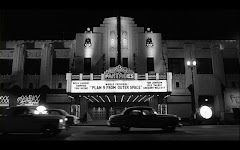
The Movies Go to the Movies: Ed Wood

Ed Wood (1994, Tim Burton)
The Pantages Theatre, Hollywood, CA


"This is the one, this is the one I'll be remembered for"

Seeing as I am as much a movie theatre geek as I am a movie geek, I thought I'd add a new feature (because if there's one thing my blog needs-it's another rarely updated feature!) consisting of shots of movie theatres in movies. Caveat: I plan on focusing on theatres I've been to or whose locations (current or old) I am aware of, which pretty much consists entirely of those in Northern or Southern California, the former where I grew up and the latter where I currently live, though if I catch an image of a movie theatre I know from my travels, I will include that as well.

The inaugural entry is from one of my favorite films of the 1990s, Ed Wood, a film in which screenwriters Larry Alexander and Larry Karaszewski and director Tim Burton recontextualized their subject's life, the man considered the "worst director of all time", as a triumph, whilst not completely dismissing personal issues (alcoholism, exploitation of friends). The screenwriters accomplish this by structuring the film around Wood's friendship with Bela Lugosi and telling the story entirely from the director's perspective. In the DVD commentary the writers make mention of how Sarah Jessica Parker's character was seen by many a viewer as a villain, but in reality she was saintly to a fault and stayed with him long past the point most would.

Ed Wood also has a personal connection for me. In 1993, I was assisting my uncle, a low budget horror filmmaker in his own right, with a film shoot on a day when a few blocks down Burton and company were shooting a scene on Hollywood Blvd (a scene of Martin Landau and Johnny Depp walking and talking). I got to see a couple of takes and how much loving detail the filmmakers put into recreating the era, which is evident in the film with it's black and white cinematography and drunk in love with the B-movie ethic of the era tone.

The Pantages Theatre opened on June 4th, 1930. Howard Hughes purchased it in 1949 and in the fifties it served as home for the Academy Awards. In 1977 it shifted from a cinema to a live theatre venue. For the last two years Wicked has been in performance there. Three years ago, I saw a concert by a person with a slightly higher critical artistic reputation than Mr. Wood, Bob Dylan.

Just a guess, Plan 9 From Outer Space probably never played there.

Tuesday, May 27, 2008

The Best Thing About the New Indiana Jones Movie...

...was the attached trailer for David Fincher's new film, The Curious Case of Benjamin Button, based on a F. Scott Fitzgerald story about a man aging backwards starring Brad Pitt as the eponymous Mr. Button with Cate Blanchett and Tilda Swinton.

In case you missed Indy, your theatre didn't have it attached to your print or you were distracted by the confused reaction it elicited in your audience, here it is...en espanol (for some reason an English version is unattainable) but since the imagery and mood evoked are the most indelible aspect of the trailer, nothing much is lost in translation.


Despite committing the trailer sin of using a piece of music best identified with another film, in this case "Aquarium" by Camille Saint-Saens, given the fact that that music is most associated with Terence Malick's Days of Heaven and Visions of Light, the documentary about cinematography, I'll excuse it as an homage and possibly a throw-down announcement that this film is going to bring it beautiful image-wise.

It opens December 19th.

As for Indiana Jones, enough finger sweat has been spent on it already. It's pretty "eh" for me, definitely not as bad as some naysayers will have you believe but I am afraid any over-enthusiastic responses are probably due to a Pavlovian response to the familiar milieu.

Some personal notes (Beware Spoilers):

The Good:

--The opening Paramount Pictures mountain logo dissolves literally into a "molehill", a clever joke on Spielberg's part admonishing to the template while accepting that perhaps the audience is putting too much stock in it's need for this sequel.

--Cate Blanchett imitation of Natasha from The Rocky and Bullwinkle Show worked for me surprisingly more than either her Kate Hepburn and Bob Dylan impersonations.

--Indiana Jones' reaction upon seeing Marion Ravenwood for the first time and his admittance that despite all the other girls, the problem was: "None of them were you". I wonder how Spielberg's wife feels about that meta-commentary on the annoyances and blandness of the other Jones' girls.

--Ford's fedora grab from Shia LeBeouf in the last scene.

The Not-So-Bad

--Harrison Ford is more vibrant and alive here than anything he's been in since, oh, Air Force One? The Fugitive? Unfortunately, that still equates to half-somnambulist.

--I was fearful of Mr. LeBeouf, but he's actually okay here, keeping his inherent smugness to a minimum. Also grateful that the not-so-stunning reveal of Mutt William's heritage occurred fairly early.

--The reveal of the Ark of the Convenient was cute, if a little pandering.

--Structurally, the film "felt" like an Indiana Jones film, which is more than I can say for the Star Wars prequels.

--It was great to see Karen Allen, but with the exception of some driving duties, Marion Ravenwood is given very little to do.

The Bad

--A potentially great chase scene soon unravels when Spielberg and company go overboard on the CGI. Look I realize that CGI is unavoidable, but it shouldn't be so distracting. My favorite film of last year, Zodiac, is full of CGI, but it's weaved into the fabric of the cinematography stealthy enough that I was never once taken out of the film. I feel especially disappointed because Spielberg normally utilizes CGI effectively, as evidenced in Jurassic Park and AI. I don't want to bag on Lucas, since he didn't actually "direct" Crystal Skull, but it felt like the Star Wars prequels where so much visual stimuli occurs in the frame that the viewer is assaulted into exhaustion which soon evolves into boredom. Same goes doubly for the final set-piece which is pretty much consists solely of actors shot on green screens reacting to bad computer graphics.

--The "MacGuffin" that so excited George Lucas...what the fuck? Keep it simple, bro.

--Two words: The monkeys.

While I had a decent enough time, unfortunately nothing in the film got to me the way the two minute trailer that preceded it did. It was like an evening spent with old friends you haven't seen since high school. It was nice to see them again, learn what they've been up to, but there was a reason that you haven't seen them in years and despite some precursory niceties, you probably won't ever see them again.

And I definitely have no interest in seeing Mutt Williams and the Spooky Spectral Break-In at Watergate.

Monday, May 5, 2008

Son of Frankenstein (1939, Rowland V. Lee)

Though not held in as high esteem as either the two preceding films in the franchise(the eponymous first and follow-up Bride Of…), Son of Frankenstein is a worthy addition to Frankenstein lore. Of the three principle members of those first two films, only Boris Karloff returns in his role as the monster; director James Whale is replaced by journeyman Rowland V. Lee, and Colin Clive, Baron von Frankenstein, passed away two years prior (at the age of 37) of pneumonia. Lee proves an able substitute as director, deft at adapting to the stylistic milieu Whale established. While Bela Lugosi as Ygor and Basil Rathbone as the titular offspring of the good doctor prove spirited additions to the cast.

Sixty plus years later, the original Universal Horror films might not posses the ability to truly scare modern audiences weened on an ever increasingly extreme genre the way they did in their era, however, they preserve due to the quality of their distinct expressionist idiom and thematic subtexts. And boy does Son have art direction and set design style to spare! In the film, Wolf von Frankenstein (Rathborne) returns to the castle of his father, now sparse and decaying. The angled design, haunted ambiance of the sets and heavy reliance on shadowy juxtapositions are so pronounced that they must bring a tear to the eye of Tim Burton. For example, here is the Frankenstein family dining room:
How are you not supposed to experiment with manufacturing human life when you have your morning cup of coffee here?

Resurrection is an essential theme of the entire Frankenstein movie series (as well as, obviously, Mary Shelley's novel) it also unifies three of the main characters in Son. Ygor (spelling in credits, although I've seen it spelled with both an "E" and "I" in other circumstances) has survived a public hanging and proclamation of his own death for his responsibility in the grave robbing of the first film. He is, uh, bitter. He manipulates Rathbone's Baron Wolf von Frankenstein (awesomest horror name...ever) to take up the work of his deceased father which he considers an opportunity to restore his ostracized reputation. Frankenstein, already on the precipice of obsession in regards to his father's work, requires little convincing to resurrect the lifeless monster from his "death" in the climax of Bride. As in the original novel and first two films, the lesson is, the dead really ought stay that way.

Bela Lugosi who famously rejected the opportunity to play the monster in the original Frankenstein, shines here as the true villain of the piece, going over-the-top early and often. In the process he redefines the role of Ygor from subservient man-child to a master schemer (he, "pulls the string" if you will) manipulating Frankenstein to resurrect the monster who he then uses to do his own biding for personal vendettas. Rathbone also brings the right air to his role. He never tries to replicate Colin Clive's iconic performance, managing to create within his own unique persona the same obsessive qualities as Clive. His Frankenstein is a man constantly confronted with the sins of his father and often falls prey to those sins in himself. This marks Karloff's final performance as the monster, and a sense of disinterest, or at the very least sameness, is apparent, perhaps due to the regression of his character who goes back to speaking monosyllabic grunts instead of further forming language as in Bride. He's also for reason completely unexplained, wearing an unflattering huge fur sweater over the famous size-too-small suit, proving Ygor to be as adept at costuming as he is at brain finding. And while we are on the subject of the film's performances, Donnie Dunagan, as the grandson of Frankenstein gives one of cinematic history's most obnoxious child performances, due in large part to a voice which is several octaves above Shirley Temple's. He would later voice Bambi; it cannot be denied he's the right temperament for that role, but imagine that voice in a gothic thriller. A little distracting.

As the first film to not adhere at all to the plot of Mary Shelley's original novel (though both of Whale's films were loose adaptions to say the least), director Lee and screenwriter Wyllis Cooper are afforded the opportunity for some meta-commentary. The previously mentioned exaggerated sets are a playful satire and tribute to the design construct of Universal monster films in general, and very early Baron Wolf expresses exasperation at people who mistake his family name as the name of the monster,a nod to one of filmdom's most frequent perception errors (kind of like how Mrs. Voorhees not Jason is actually the killer in the first Friday the 13th). The theme of desire for friendship amongst the socially alienated that resulted in the monster's demand for a mate is mirrored in Ygor who desperately insists to the monster that he is his true "friend". In the denouement, Boris Karloff's monster is redeemed when he does not throw a child into a body of liquid (sulphur instead of a lake) a callback to the monster's fatal playful mistake in the first film.

The film is an epic by comparison 99 minutes long (all others in the series tend to waiver somewhere between 65 to 80) and was originally intended to be the first Universal Monster film shot in color.

Son of Frankenstein as well as two other entries in the franchise (the still unseen by myself: Ghost of Frankenstein and House of Frankenstein) was included on the Frankenstein Legacy Collection DVD that came out a couple of years ago to capitalize on the release of the godawful Van Helsing. The other Universal Monsters (Dracula, The Wolf Man, The Mummy, Invisible Man and Creature From Black Lagoon ) also received similar DVD sets featuring 4 to 5 movies in unison. As far as "threequels" go, it's respectful of what came before and succeeds in adding to the legacy, instead of coasting on past glory. And, needless to say, it's a hell of lot better than Van Helsing.
Related Posts with Thumbnails